
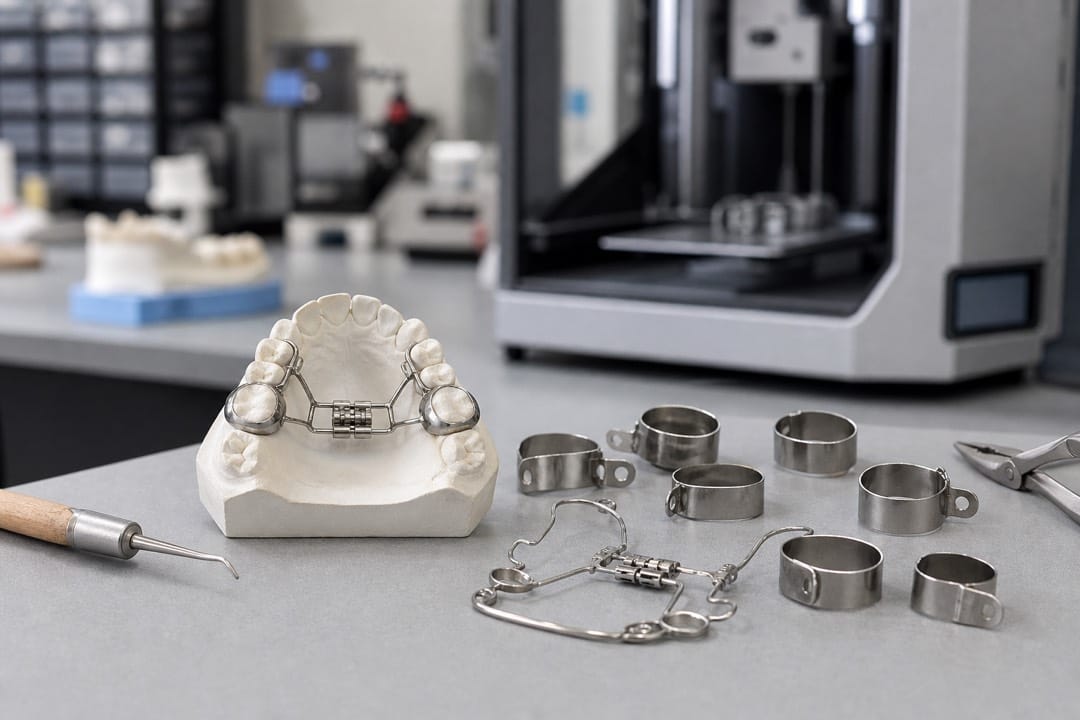
Digital Bands Change the Orthodontist's Chair Time
Orthodontic appliance lab equipment Toronto practices invest in today targets the appointment orthodontists hate: separator placement, multiple band size trials, and chairside adjustment on poorly fitting molar bands. Custom bands designed from intraoral scans fit the tooth anatomy on first delivery when design parameters for cement space and occlusal clearance are set correctly. GTA orthodontic labs feeding practices in Mississauga and downtown Toronto see demand for faster band turnaround as clear aligner competition pushes traditional ortho to improve service speed. Lingual sheaths and habit appliances still dominate some Toronto ortho boards, but metal printing enters when molar bands need custom torque arms that stock bands cannot deliver. Count weekly band orders across your top three referring practices before sizing a print cell; one high-volume ortho office can justify a significant share of your metal print capacity. Equipment decisions hinge on weekly band count.
Get in touch, we're here to help
Send us a message using the form below and we’ll get back to you shortly!
Band and Expander Design on Screen Before Metal Prints
Rapid palatal expanders need screw channel alignment verified in software because post-print modification is impractical on sintered cobalt-chrome. Screw housing threads in RPE bodies must clear palatal tissue by a verified margin before nesting. Train junior designers to flag second molar bands with subgingival margins that scans captured poorly; printing them anyway wastes a build and erodes orthodontist confidence faster than a late delivery. A metal 3D printer for orthodontic appliances produces band bodies and expander frameworks with wall thickness repeatability that hand fabrication varies by technician experience and waxing technique. Design software with orthodontic modules stores band templates by tooth number, reducing design time on repeat orders from the same practice. Resin-printed indirect bonding trays from the same scan file reduce bracket placement appointments while metal bands cure in the furnace cycle. Pair band workflows with resin printing for trays and models on a separate bench so metal powder handling stays isolated.
Finishing QC Orthodontists Actually Notice
Orthodontists reject bands for internal roughness, incorrect torque in the band body, and expander frameworks that bind at activation. Build orientation during printing determines which surfaces need hand touch-up afterward. Train designers to flag cases with unusual anatomy, second molars with short clinical crowns, or expander cases with narrow palatal vaults before they reach the build queue. Toronto ortho labs competing on turnaround publish internal SLAs: scan received Monday, design approved Tuesday, print Wednesday, finish Thursday, ship Friday. Deviations should trigger a root-cause log tying failure to scan, design, print, or finish so your orthodontic appliance lab equipment Toronto partner reviews data quarterly instead of guessing. Orthodontic appliance lab equipment Toronto suppliers should provide case-specific training, not generic metal printing demos using industrial sample parts. Track remake rates by orthodontist client; one practice sending poor scans creates band failures that look like lab error until scan quality improves. Keep spare FEP films near resin printers when implant guide season runs three builds deep nightly.
FAQs
Can digital bands eliminate separator appointments for Toronto orthodontists?
Properly designed custom bands reduce sizing visits, though clinical protocols vary by orthodontist preference and case complexity.
What design parameters matter most for molar band fit?
Cement space, occlusal clearance, band wall thickness, and accurate capture of buccal and lingual contour from the scan file.
How long from scan to delivered band in a GTA ortho lab?
Digital workflows often deliver bands in two to four business days once design templates and print queues are established, compared to longer wax-and-cast cycles.
Should ortho labs print bands and make retainers on the same equipment?
Retainers often stay on different materials and workflows. Bands and RPE frameworks suit metal printing; many retainers remain thermoformed or printed in resin separately.
What causes printed expanders to bind at first activation?
Common causes include incorrect screw channel angulation in design, warped frameworks from improper support removal, or heat treatment parameters not matched to material spec.
Your business deserves the best solutions
Let's connect and elevate your business!