Competency Gaps Training Must Close
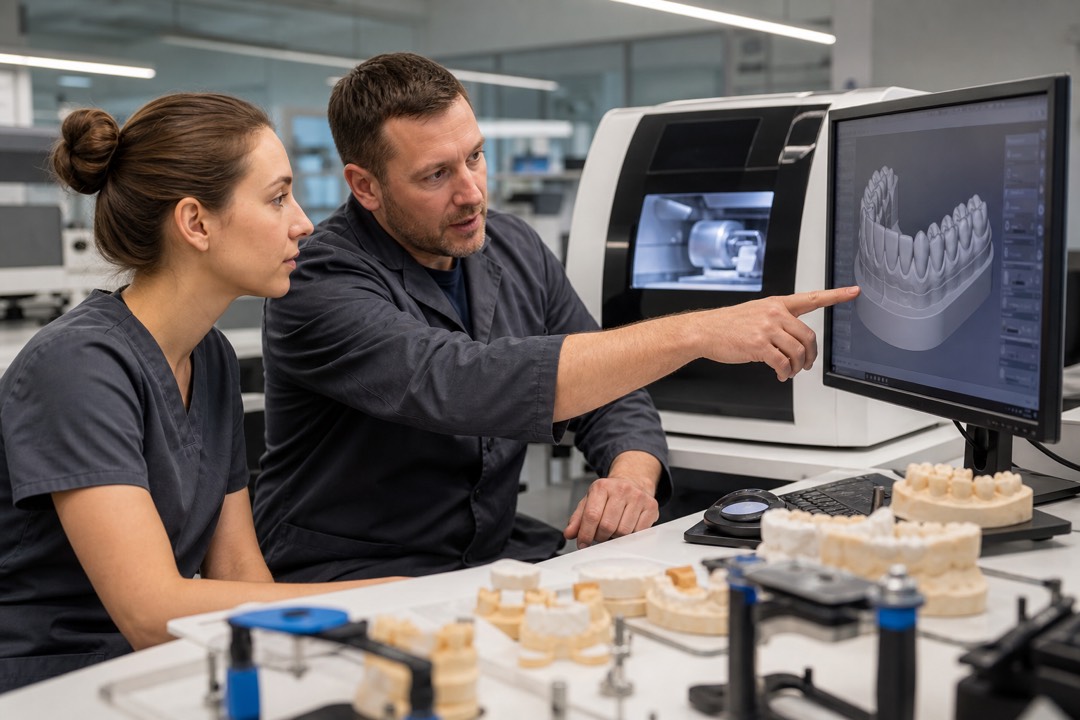
Dental CAD/CAM training Ontario programs fail when they teach buttons without biology. Technicians who memorize design clicks but do not understand occlusal clearance produce crowns that look perfect on screen and fail at insertion. Training must connect margin placement to cement space, contact design to post-milling polishing access, and nest orientation to sprue marks visible on anterior restorations. Dental CAD/CAM training Ontario cohorts should grade margin placement on extracted teeth mounted in typodonts, not only screen meshes, so trainees feel how 0.1 mm excess cement space changes insertion resistance on real anatomy. Occlusal adjustment judgment cannot be taught from PDF slides; include paired designer-finisher sessions where trainees mill a crown then watch insertion feedback from a cooperating clinic. Assess implant case training separately from single-unit crown modules because margin protocols diverge significantly on custom abutment workflows. Ontario labs hiring from traditional wax-and-cast backgrounds need more design hours than mill hours initially because file quality determines everything downstream.
Get in touch, we're here to help
Send us a message using the form below and we’ll get back to you shortly!
Curriculum Structure for Multi-Platform Labs
Split training into modules: design on CAD/CAM software, CAM on your mill, and operational workflow on your resin printer if applicable. Cross-train at least two staff per module so vacation coverage does not stop production. Thunder Bay labs cannot fly technicians to Toronto monthly; hybrid training ships recorded design modules plus one on-site mill week beats either approach alone. Cross-train account managers to recognize invalid STL uploads so cases never reach designers who waste an hour repairing non-manifold meshes from careless clinic exports. Printer training modules should cover failed-build recovery so night staff restart jobs without calling daytime supervisors. Document pass/fail criteria: can the trainee export a three-unit bridge STL without errors, nest it, mill it, and pass QC checklist unassisted? Dental CAD/CAM training Ontario delivery works on-site for hands-on machine time and remote for software refreshers between visits. Store competency checklists in a shared drive with date stamps for internal quality audits and corporate lab group reviews. Record sessions for new hires; provincial labs with high turnover cannot afford repeating full-week courses every quarter.
Measuring Training Impact on Remake Rates
Compare remake percentage 30 days before and 60 days after training cohorts complete. Effective dental CAD/CAM training Ontario investments show measurable drops in design-related remakes even before mill-related remakes fall. Track time-to-competency per trainee: some designers need 40 live cases before independent bridge work, others 15. Dental CAD/CAM training Ontario budgets should flex with individual pace, not fixed class sizes. Remake codes tagged trainer versus trainee clarify when refreshers target teaching gaps versus production habits. Track which case types still fail QC and schedule targeted refreshers on those modules only. Schedule refresher drills when Ottawa labs add multilayer zirconia contracts that change nesting rules designers memorized six months ago. Training is not finished at install; add sessions when you activate new exocad modules, introduce multilayer zirconia, or onboard a second shift.
FAQs
How many training days do Ontario labs need at install?
Most labs require three to five on-site days split across design, CAM, and QC, plus remote follow-up sessions during the first production month.
Should designers and mill operators train together?
Initial cross-training helps both roles understand file decisions affecting production; advanced modules can separate once basics are competent.
Can training happen remotely for Ontario labs far from GTA?
Software and CAM training suit remote delivery; hands-on mill and printer sessions still benefit from on-site time at least once during rollout.
How do labs document training for quality records?
Keep signed competency checklists, session recordings, and QC audit logs linking trained staff to cases they produced.
When should Ontario labs schedule refresher training?
After staff turnover, when remake rates spike on specific case types, or when activating new materials and software modules.
Your business deserves the best solutions
Let's connect and elevate your business!