
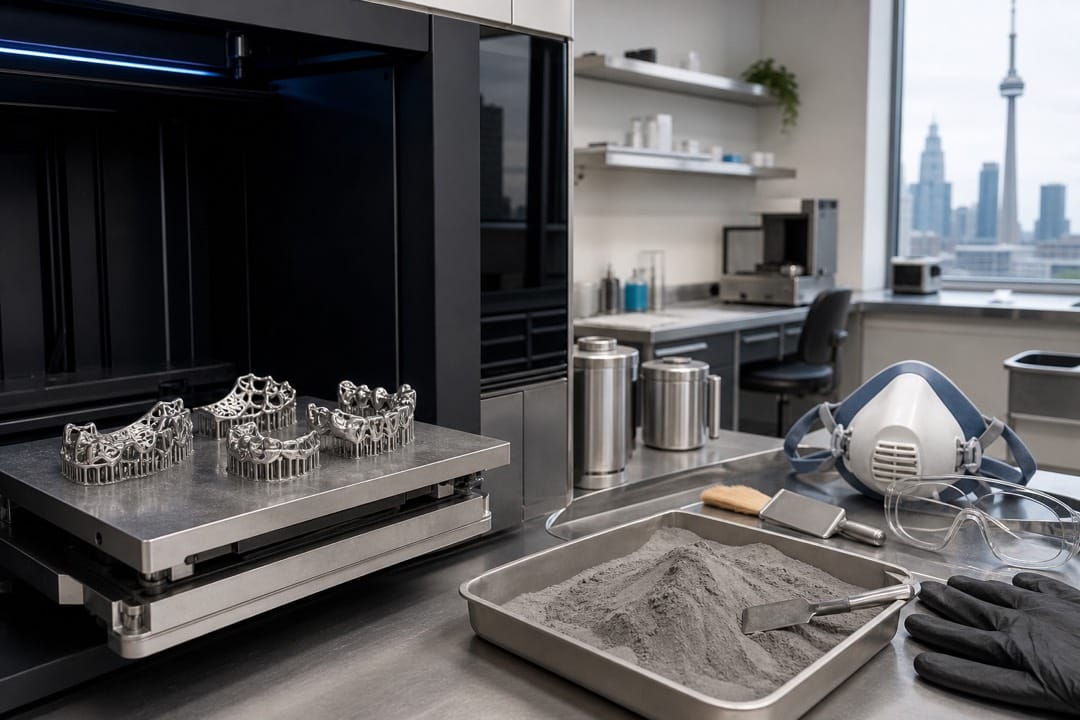
Why Toronto Removable Labs Adopt Metal 3D Printing
Metal 3D printing dental lab Toronto production solves problems waxing and casting repeat weekly: inconsistent clasp thickness, investment bubbles near mesh connectors, and framework distortion during divesting that shows up only at the clinic try-in. Digital RPD design locks clasp arm gauge and occlusal rest depth before powder ever loads into the build chamber. Hand-cast RPD clasps vary in elasticity when wax temperature swings between morning and afternoon benches. Digital frameworks reproduce clasp gauge consistently on repeat orders from the same referring practice. Toronto removable teams serving aging populations in suburban and downtown markets often see higher partial denture volume than boutique cosmetic labs, which makes print consistency a revenue issue, not a novelty. Toronto humidity also affects investment drying times in analog casting; powder-bed fusion removes that seasonal variable from your production calendar. Powder-bed fusion also suits orthodontic bands and palatal expanders when case volume justifies the capital and safety infrastructure.
Get in touch, we're here to help
Send us a message using the form below and we’ll get back to you shortly!
Design Validation Before the Build Starts
RPD frameworks fail clinically when major connectors are too thick, clasps engage undercut too aggressively, or support structures leave scars in tissue-contact zones. CAD/CAM design software with partial framework modules lets technicians simulate clasp flex and adjust before printing. A powder-bed fusion metal 3D printer reproduces digital geometry within tolerances hand waxing cannot hold on repeated orders from the same clinic. Toronto implant specialists who fabricate temporary RPDs alongside healing abutments appreciate frameworks that seat without rock on first clinic delivery. Compare print parameters against your cobalt-chrome alloy certification sheet before committing to a production recipe. Heavy clasp adjustment at try-in usually traces to scan distortion at the distal extension, not printer malfunction. Build orientation determines surface quality on tissue-facing surfaces and how much support removal labor follows each job.
Powder Handling and GTA Production Scheduling
Cobalt-chrome powder is never inert in the lab environment. Train every technician on spill response, recycling ratio limits, and when to discard powder lots after moisture exposure. Toronto humidity swings between seasons affect powder storage more than climate-controlled mills do; sealed containers and desiccant protocols belong in your SOP from day one. GTA labs sharing bench space with zirconia milling should partition powder handling behind physical barriers and posted airflow signs. Run metal jobs early in the week so cleaning and heat treatment finish before Friday removable rush freight leaves for suburban clinics. Schedule metal builds around removable delivery promises: a Friday RPD try-in means support removal and finishing must finish Wednesday, not Thursday night. Preventive maintenance on laser optics and gas filters prevents mid-build aborts that waste powder and miss clinic dates. Source cobalt-chrome powder and filters through authorized shop inventory so Toronto removable rush weeks do not stall on freight gaps. When clasp tension reports come back from a clinic, trace design thickness, print parameter set, and finishing technique before reprinting blindly.
FAQs
Which removable cases suit metal 3D printing best in Toronto labs?
Cast partial frameworks with complex clasp paths, repeated orders from the same clinic, and cobalt-chrome designs with thin connector zones benefit most from digital consistency.
How much post-processing does a printed RPD framework need?
Support removal, heat treatment per material spec, surface finishing on clasp arms, and fit verification on a cast or scan model before shipping to the clinic.
Is metal 3D printing safer than casting for Toronto lab staff?
Both require protocols. Printing eliminates molten metal burns and investment dust but introduces powder inhalation risks managed through PPE, extraction, and supplier training.
What build orientation reduces clasp adjustment chairside?
Orient tissue-facing surfaces away from dense support zones and validate clasp flexibility in design software before nesting to minimize support contact points on functional surfaces.
Can a Toronto lab start with RPD printing before orthodontic metal cases?
Yes. Many labs master removable frameworks first, then expand into bands and expanders once powder handling and finishing workflows run reliably.
Your business deserves the best solutions
Let's connect and elevate your business!